
'Twas a wet day yesterday but one that found us arising early and shephering the little ones into the car, still yawning and sleepy eyed, and beginning a very long drive to just "over the river" to the city of Keokuk.
 It was a little disappointing to not make it out for the entire weekend, espcially when we heard, once we arrived, from more dedicated campers, that the prior evening had been fine and lovely. However, it did rain quite a bit while we were there so I suppose it is a good thing we did not take all our canvas out to have to pack up and haul away while wet.
We enjoyed ourselves for the time that we were there. The last time I was in Keokuk was 2005 - the year I met David - and so it was nice to be back once more. The park is lovely, though in the middle of the city, and with the gray foggy mists that gently settled on the damp grasses, the trees, whose wet bark was made darker by contrast with the green of leaves, it was very beautiful and romantic and dream-like.
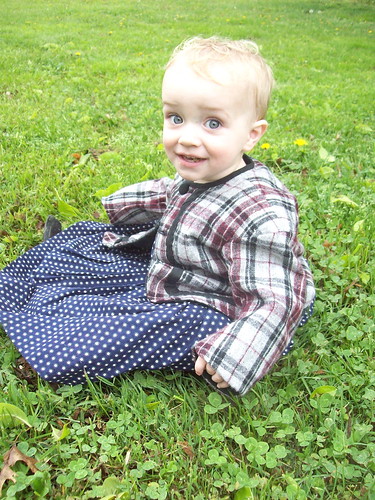 The remainder of our medical unit, the 108th IL, also came up just for the day.
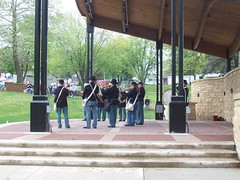 We walked the paths, browsed the sutler tents and at last we settled down in a pretty spot near the outdoor stage, from whence came jubilant and exciting music from the 33rd IL band and the boys roamed the low "ditches" and played the leaves and with rocks and sticks they found. The occasional mud puddle was a delightful thing for them.
 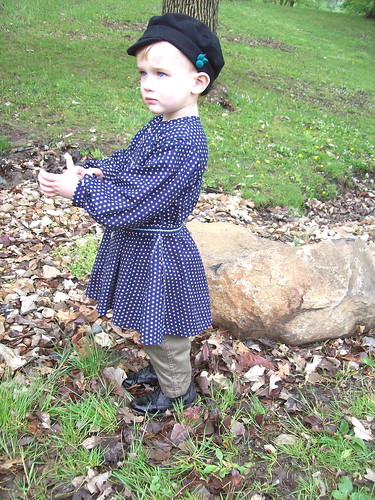 For lunchtime we spread a little picnic we had packed and ate by the shores of a small and pretty pond.
 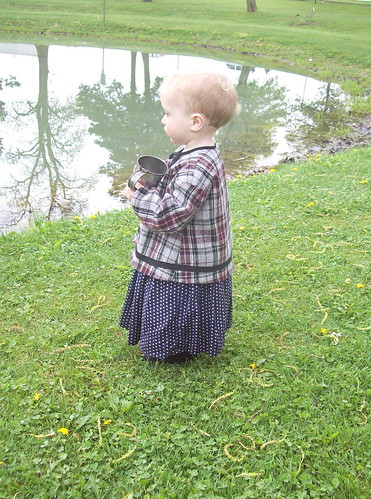 We had, in the words of the boys "Sausert" (sausage) and cheese and bread with cups of water and for dessert shortbread cookies which are wonderful since they do not stain clothing. It was simple and satisfying fare and easy to clean up afterwards, just requiring a shaking out of cups and a brushing off of crumbs. No sweeping or dish washing necessary! :)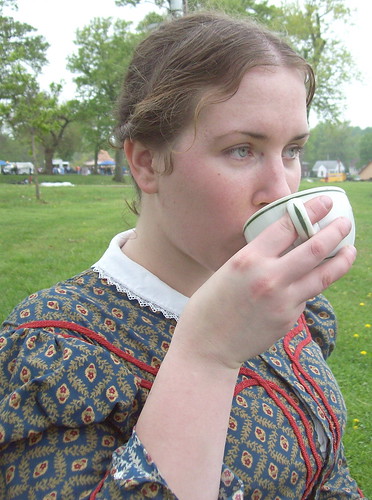
My beautiful white and green cup, just minutes before Malachi dashed it to pieces on the concrete
The boys behaved themselves very well, except for Malachi who is not yet very accustomed to walk in the same direction as us, nor does he think hand holding a very desirable or useful practice. He was carried half the time by me and the other half of the time he walked - whether his desired direction was also our desired direction was entirely a matter of chance, you know. Since we really had nothing in particular to do or anywhere in particular to go, we enjoyed slowly meandering about. 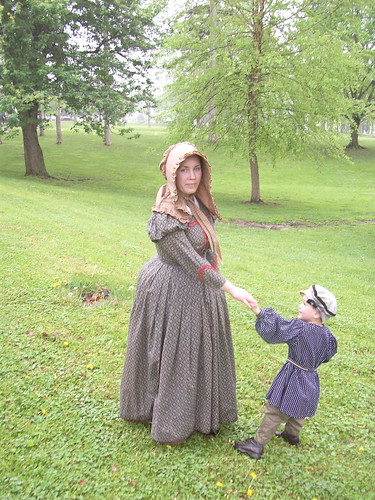 (In retrospect, my bum-pad seems a bit. . .too. . .ah, bummy. I look like I weigh 250 lbs. here! And slat bonnets are terribly unflattering though they ARE practical)
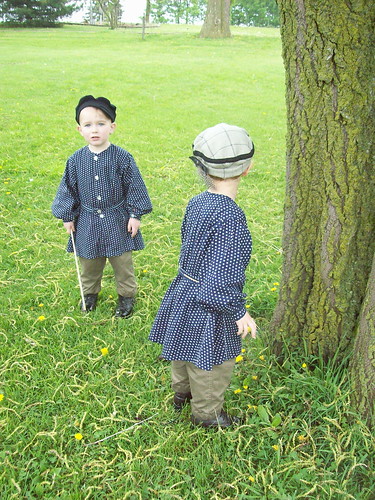
(In retrospect, my bum-pad seems a bit. . .too. . .ah, bummy. I look like I weigh 250 lbs. here! And slat bonnets are terribly unflattering though they ARE practical)We met and talked to lots of lovely people; we saw a beautiful brand-new darling little baby boy reenactor, we learned how to bake bread in a dutch oven using coals from a sweet gentleman from Columbia, MO, we saw a photo of an Iowa officer who looked uncannily like David, we got ginger bread men from a friendly group of LDS members who shared with us about the historic site of Nauvoo, closely located, we got striped candy sticks for the boys and had our picture taken more times than I can remember.  (As an aside, I used to never get my photo taken when I was still single nor before we had children; but now we are very popular! This strange occurance seems to be the effect of three certain small boys in our possession).
(As an aside, I used to never get my photo taken when I was still single nor before we had children; but now we are very popular! This strange occurance seems to be the effect of three certain small boys in our possession).David and Judah hit the tree with a bit of stick they found by the pond
In the afternoon the battle was to take place. Since the rest of our medical unit had already left David was asked to be acting surgeon for the 108th IL. He carried his doctor bag and left for the field of battle along with the troops while the boys and I more slowly made our way up the hill to where the fray was to take place. We never quite made it all the way up. Another ditch was discovered, full of leaves and puddles and sticks, quite tempting to small boys. Malachi ran towards it as fast as his fat be-stockinged and booted legs could carry him and tumbled headlong into it, falling with force upon a soft bed of dead leaves. He was stunned at first, though not hurt - just suprised that he had fallen!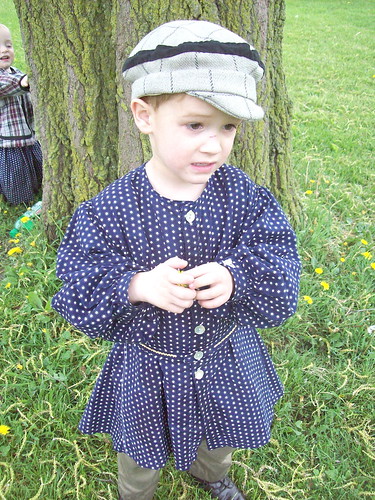 Some dear friends of mine - Van and Katherine - were at this point seen approaching.
  They made their way to us and we spent the duration of the battle in conversation with Katherine and I at times making dashes for a wayward child. In the midst of the booming cannon, Malachi fell asleep.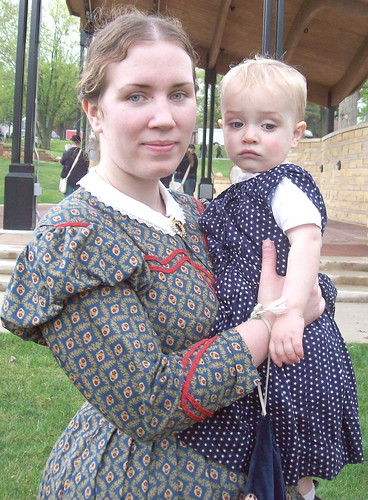
Me and a very tired Munchkie-Poo - don't you love his delighted expression? :)
Now I am trying hard to get the mud stains out of our clothes. I'm so glad I dressed the boys in their play outfits instead of their dressier tunics! The dark blue and white spotted fabric really hides stains very well and I think with a thorough washing and a pressing once they are dry they will be as good as new again. All of our white underwear is in a sad state though. The dirt seems to have a very reddish tinge to it which bespeaks clay and I don't know if that will ever completely come out. My new petticoats too! Sigh. But, it is at least an authentic stain and is really a part of the whole experience!
Love,
Sarah


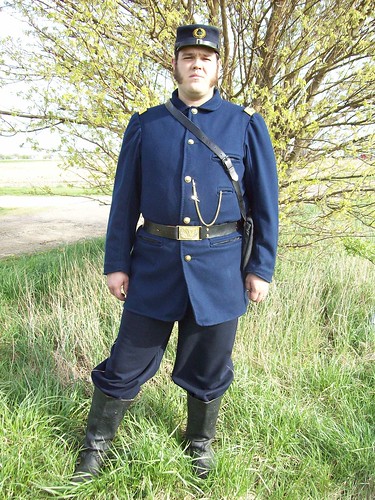 One area that officer sack coats differ from enlisted issue sack coats is in length. Regular sack coats had just 4 buttons and officer coats boasted 5 buttons and extra length. They could also include details not found on enlisted sack coats like extra pockets, different collar styles and could closely resemble civilian wear of the day. Officers did not have their clothing issued to them but, from what David tells me and what I have read, were issued a clothing allowance with which to purchase their different uniform parts. Thus, a LOT of variation can be found in extant original officer uniforms since they were made by personal tailors and could include variations based on the desires of the officer in question. David personally likes to stick pretty closely to regulations but this was not always the case in the period.
 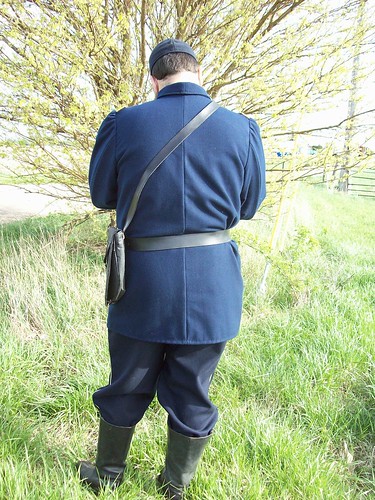 David's coat is made from dark blue wool flannel from Wambaugh and White and his trousers made from dark blue kersey from the same company. The body is lined with black cotton sateen and the sleeves with white pima cotton. The buttonholes were done with silk twist from B. Black and Sons. The pattern was Charlie Childs federal fatigue blouse pattern, altered for length. I also had to make some adjustments at the side seams and shoulders and neckline to fit David's particular figure. He wanted six pockets so he has two inner pockets sewed into the lining and four outer pockets.
 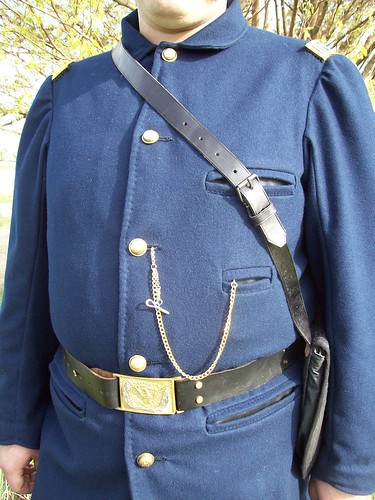 I am pretty happy with how it came out although, as always, there is room for improvement. David did complain less about this particular coat than he has about previous coats. His only gripes were the gathers in the sleeves (he likened them to the wide puffy sleeves popular in the 1980's, even though many pictures of original coats depict light gathers or easing in the sleeve heads) and the pockets, the edges of which to don't remain together when the coat is worn. (although the pictures of the original coat I was copying a lot of details off of had slumpy pockets too!)
 The pattern calls for silk taffeta, but due to budget constrains (silk can be expensive!) Nona purchased royal blue satin instead. The accent fabric is a matching royal blue velvet that was recycled from an old underskirt of hers. The lace around the neckline and sleeves was also recycled from another skirt she used to wear. The lining for the bodice and sleeves is white cotton.
  I followed the pattern fairly well (for me) but did make a few alterations. For instance, I did not use the skirt pieces guide given in the pattern but cut and sewed three panels (50” wide) together for the skirt and balanced the length at the waist. Mid-19th century skirts are so simple to make, they do not really require a pattern at all. I did not really follow the instructions. If you have a basic knowledge of mid-19th century construction techniques it is not hard. It becomes ingrained in your mind so that you do it automatically. But for basics; the bodice is flatlined, the seams sewn and pressed to one side (not open). The opening is pressed under to create a self facing and stitched down. The raw edges on top and bottom are bound or piped, and the sleeves set in (usually with narrow self fabric piping in this seam). I also covered every seam in the bodice with tape to finish it off nicely and the front seams are boned.
 This pattern seems to run large. We cut the bodice (for a mock up) in a size 18, which seemed to be the correct size based on the measurements we took. However, it was so large that even when it was pinned closed in the back it still slipped right off! The pattern says that 6” of wearing ease are added above the natural measurements of the person it is meant for! That is WAY too much wearing ease! We took the pattern in a lot and then I traced off the fitted pattern onto fresh paper. (ALWAYS trace off a pattern, once you have nicely fitted it, so you don’t have to go through the inconvenience of such a fitting again unless you change size).
  It was a little tricky working with the slippery satin and velvet. I had to sew much of the dress by hand with it lying flat on a table so it wouldn’t shift around. The finished dress doesn’t look as “crisp” as the dress on the pattern cover (made of silk taffeta) but well, satin is a slippery, soft fabric. For decoration I sewed blue bead fringe to the outer edges of the bretelles (which are of velvet, bound in satin), around the sleeve hems and across the neckline. The same bead fringe also is sewn to the bottom of each tab. The tabs are reversible and sewn to a separate waistband than the main skirt, so it can be worn in a variety of ways. One side is satin and the other velvet, with the gathered “petals” on the velvet side made of satin and on the satin side made of velvet. For additional trim I sewed on the satin and velvet covered buttons to correspond to the pattern. Around the edge of the neckline lace I sewed tiny glass seed beads and ran a blue satin ribbon through it to draw it up when it is worn.
  Today I sewed on the last petals and made the head-dress. The headdress is made like a decorated hairnet but is constructed of slightly different materials, to match the dress. Using small scraps of satin and velvet I made seven rosettes, which were sewn to a wired base. Inside each rosette I attached a blue silk flower and a tiny blue silk ribbon rosebud. The hairnet part is made of fine black net and has an elasticized bottom edge for ease of wearing.
 Now the ball gown bug has bit me and I have been shopping around online a bit for silk fabric. I have always wanted a pale pink or pale yellow silk taffeta evening dress or ball gown, either solid or in a large plaid. Pink and yellow seem to be hard colors to find. Not that I need a ball gown. We don’t go to events that have balls. Most are just outdoor dances or, at most, a barn-dance where a day dress is far more appropriate to wear. Still! One can plan. . .in the meantime, I'm very excited about the straw bonnet I just ordered from